Lac Dye vs Carmine (E120) — Chemistry, Shades & Regulation
Two insect reds that buyers often confuse. How red lac dye and cochineal carmine differ in source, chemistry, shade and legal status, and which one fits your use.
- Red lac dye is C.I. Natural Red 25 (C.I. 75450), a mixture of laccaic acids from the lac insect.
- Carmine is the aluminium lake of carminic acid from cochineal; in the EU it is E120 (C.I. 75470).
- Both are anthraquinone reds and both need a mordant on textiles.
- Lac dye has no EU E-number and is not a listed US food colour; Japan, China and South Korea permit it under conditions.
- For silk and wool dyeing, lac dye can often stand in for cochineal after a shade trial.
Importers searching for a natural insect red usually land on cochineal and carmine first. Red lac dye is the older Asian alternative, and it is often mistaken for carmine on specification sheets. The two are related, but they are not interchangeable on paper, especially for food.
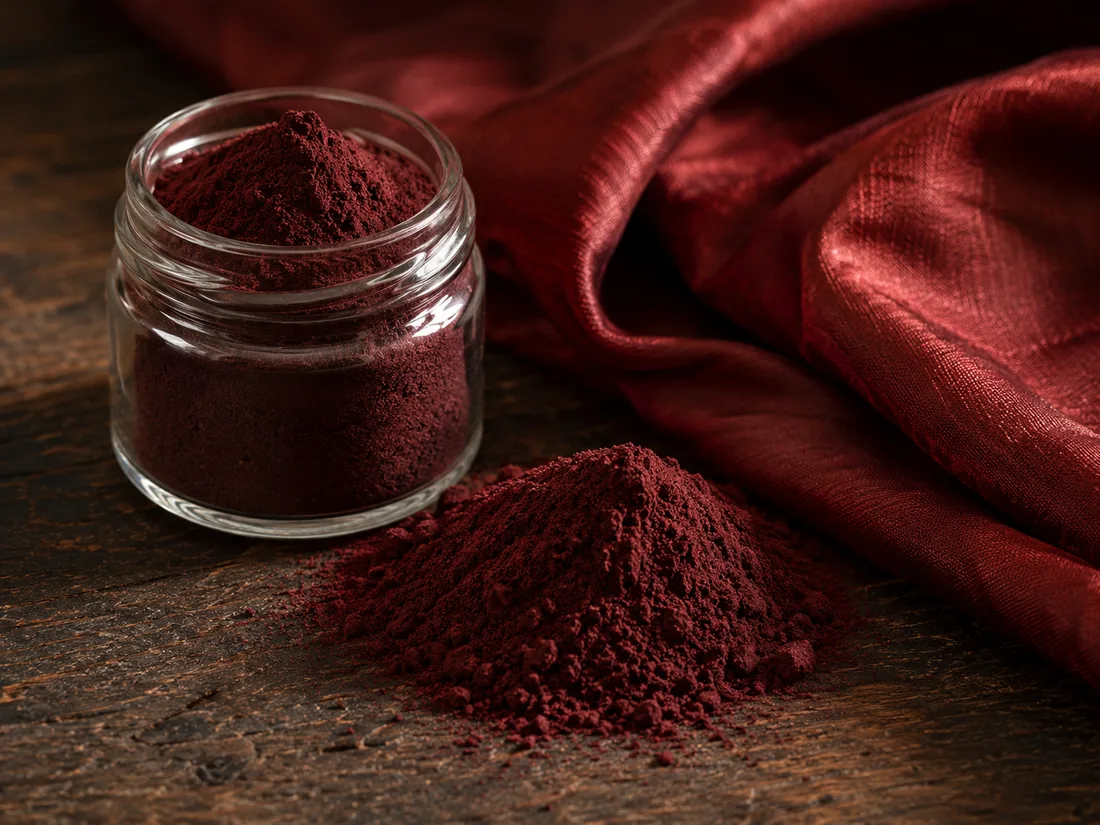
Two insects, two dyes
| Red lac dye | Carmine / cochineal | |
|---|---|---|
| Insect | Lac insect (Kerria lacca) on host trees in South and Southeast Asia | Cochineal (Dactylopius coccus) on prickly-pear cactus, mainly Peru and the Canary Islands |
| Colouring matter | Laccaic acids A–E | Carminic acid |
| Colour Index | C.I. Natural Red 25 · 75450 | C.I. Natural Red 4 · 75470 |
| How it is obtained | Recovered from the wash water when sticklac is washed into seedlac | Extracted from dried insects; carmine is the aluminium lake of the extract |
| EU food status | Not authorised, no E-number | E120 |
| HS code (typical) | 3203 00 (India: 3203 00 30) | 3203 00 |
Chemistry in plain terms
Both dyes belong to the anthraquinone family, which is why they behave alike in a dye bath. Carminic acid is a single main molecule. Lac dye is a group of closely related laccaic acids, so its shade can vary a little more from lot to lot. That is why a batch COA with dye content, and a trial skein from the sample lot, matter more for lac dye than for a standardised carmine.
Shades on silk and wool
With an alum mordant, both give crimson to rose reds on silk and wool. Tin brightens either dye towards scarlet, and an iron after-bath pulls both towards plum and purple. Both are pH-sensitive and turn bluer or more purple as the bath turns alkaline. In practice, dyers who switch from cochineal to lac dye adjust dye weight and mordant to match their standard rather than change their process. The natural dyeing guide covers mordants and bath control in more detail.
Food and cosmetics: where each is allowed
| Market | Red lac dye | Carmine (E120) |
|---|---|---|
| European Union | Not authorised | Authorised as E120, with labelling |
| United States | Not a listed colour additive | Listed; must be declared by name |
| Japan | Permitted (lac colour) | Permitted |
| China | Permitted (紫胶红, GB 2760) | Permitted |
| South Korea | Permitted, banned in specified categories | Permitted, with conditions |
This is a summary as of October 2026, for orientation only. Use limits, purity criteria and labelling rules apply in every market, and cosmetic rules are separate. Check with your regulator before food or cosmetic use. Neither dye is vegan, since both come from insects.
Which should you buy?
- Textile dyeing, crafts, restoration, research: lac dye is a direct alternative to cochineal and the traditional red of Indian silk, shawls and carpets.
- Food for the EU or US: carmine (E120), because lac dye is not permitted there.
- Food for Japan, China or Korea: either can work; check the category limits first.
Full specification, mordant table and pricing are on our red lac dye supplier page.
Quick answers
Is lac dye the same as carmine? No. Lac dye is a mixture of laccaic acids from the lac insect (C.I. Natural Red 25, C.I. 75450). Carmine is the aluminium lake of carminic acid from cochineal (E120, C.I. 75470). They are related anthraquinone reds but different molecules.
Does lac dye have an E-number? No. Lac dye is not an authorised food colour in the EU and has no E-number. E120 covers cochineal, carminic acid and carmines only.
Can lac dye replace cochineal in textile dyeing? Often, yes. Both give crimson to scarlet reds on silk and wool with an alum mordant. Shades differ slightly, so dye a trial against your colour standard.
Where is lac dye allowed as a food colour? Japan, China and South Korea permit it under conditions. The EU and the US do not list it as a food colour.
This guide summarises publicly available information and industry practice as of October 2026. Confirm current regulations for your market before ordering. It is not legal advice.
Sourcing Red Lac Dye?
Tell us the quantity, end use and destination port. Batch COA with every lot, quotes within 24 hours.