Red Lac Dye Exporter from India — C.I. Natural Red 25 (75450)
Red lac dye (C.I. Natural Red 25, C.I. 75450) is the water-soluble laccaic-acid red recovered when sticklac is washed. We supply it as a powder for silk and wool dyeing, heritage restoration and research. It is not carmine (E120) and not a permitted EU food colour. MOQ 25 kg, batch COA with every lot.
Price ₹8,000/kg (≈ US$82/kg) ex-works India, before freight · USD at ₹97 = US$1 (Oct 2026), confirmed on quote
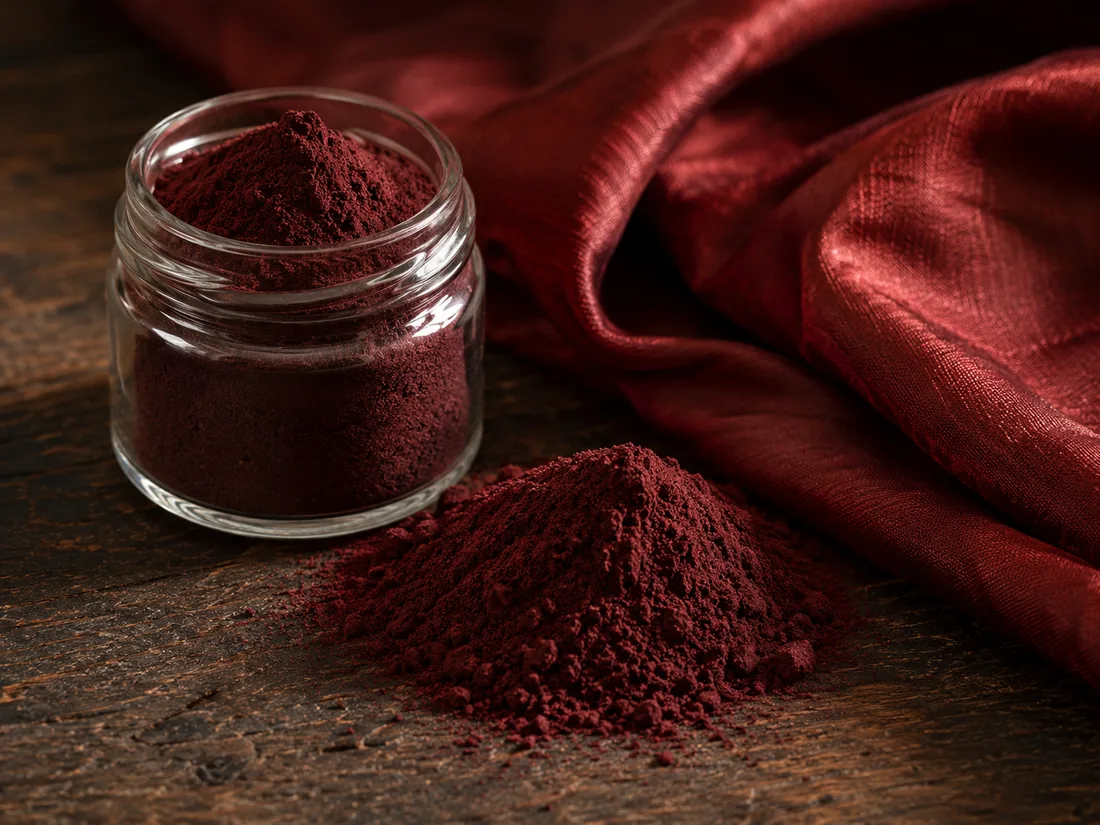
Red Lac Dye (C.I. Natural Red 25)
Red lac dye is the deep crimson colourant that occurs naturally in sticklac, recovered from the wash water when raw lac is cleaned during seedlac production. Chemically it is a mixture of laccaic acids (A–E) — anthraquinone-type molecules related to the colourants of cochineal — supplied as a dark red-brown, water-soluble powder.
It is one of the oldest textile dyes of the Indian subcontinent, prized for the warm reds it develops on silk and wool with common mordants. Today demand comes from natural-textile dye houses, craft and heritage restoration suppliers, cosmetics R&D, and laboratories working on natural colourants. Regulatory status for food use varies by country — buyers intending food or cosmetic application should confirm permissibility in their market, and we supply documentation to support that assessment.
We are a merchant exporter based in Bihar, next to the Jharkhand lac belt where sticklac is washed into seedlac. We source lac dye from processors in that belt, check each lot against its COA, and handle the export documents. For a side-by-side with cochineal, read lac dye vs carmine (E120); for dyehouse practice, see natural textile dyeing with lac.
| Property | Typical Value |
|---|---|
| Colour Index | C.I. Natural Red 25 · C.I. 75450 |
| Form | Fine powder |
| Colour | Dark red to reddish brown |
| Principal constituents | Laccaic acids A–E |
| Solubility | Soluble in water; sparingly in alcohol |
| Dye content | Batch-specific — stated on COA |
| Moisture | Batch-specific — stated on COA |
| Mordants | Alum (standard); iron or tin to shift shade — see table below |
| HS code | 3203 00 30 (lac dye) |
| Origin | India (recovered during seedlac washing) |
| Standard packing | 25 kg HDPE-lined bags / 5 kg pouches on request |
| Minimum order | 25 kg |
| Shelf life | 24 months in cool, dry storage away from light |
Values shown are typical ranges; a batch-specific COA accompanies every shipment.
Red lac dye shades by mordant
| Mordant | Fibre | Typical shade |
|---|---|---|
| Alum | Silk | Crimson to rose red |
| Alum | Wool | Deep crimson — the classic carpet and shawl red |
| Tin (small amount) | Silk / wool | Brighter scarlet; traditional, now used sparingly for safety reasons |
| Iron (after-bath) | Silk / wool | Plum, purple and brown tones |
| Tannin + alum | Cotton | Lighter pinks and reds; weaker uptake than protein fibres |
Shades are indicative. Keep the dye bath mildly acidic: laccaic acids turn more purple as the bath becomes alkaline. Dye a trial skein from the sample lot before ordering.
Where lac dye can be used in food
| Market | Food colour status |
|---|---|
| European Union | Not authorised (no E-number; not E120) |
| United States | Not a listed colour additive for food |
| Japan | Permitted as lac colour (existing food additive) |
| China | Permitted as lac red (紫胶红) under GB 2760 |
| South Korea | Permitted, but banned in specified food categories |
| Textiles, crafts, research | No food-additive approval needed |
Summary as of October 2026, for orientation only. Rules for cosmetics differ again. Confirm with your regulator before food or cosmetic use; we supply the documents for your assessment.
Where Lac Dye Is Used
Textile Dyeing
Warm crimson-to-scarlet shades on silk and wool using standard mordanting practice; a heritage dye with growing natural-fashion demand.
Craft & Restoration
Traditional pigment for heritage textile restoration, artisanal dyeing and natural-ink makers.
R&D & Laboratories
Reference natural anthraquinone colourant for research into bio-based dyes and colour chemistry.
Cosmetics Development
Evaluated as a natural colourant in cosmetic formulation where local regulation permits — documentation supplied.
Samples, Shipping & Documents for Lac Dye
| Samples | 100–500 g on request. The courier charge is deducted from your first bulk invoice. |
|---|---|
| Quotation | Price ₹8,000 per kg (approx. US$82 per kg at ₹97 = US$1), MOQ 25 kg. Freight and insurance are added by Incoterm (FOB Kolkata, CFR or CIF) — tell us quantity and destination port and we confirm within 24 hours. |
| By sea | FOB Kolkata, CFR or CIF to your port. |
| Bangladesh | By road via the Petrapole–Benapole border on FCA or DAP terms. See our Bangladesh buyer guide. |
| Vietnam | Certificate of origin Form AI under the ASEAN–India FTA, for reduced import duty. See our Vietnam buyer guide. |
| Documents | COA from a NABL-accredited laboratory, MSDS, technical data sheet, commercial invoice, packing list, certificate of origin; phytosanitary certificate where the destination requires it. |
| Payment | T/T (50% advance for new buyers) or LC at sight. |
| Packing & MOQ | See the specification table above; private-label packing on request. |
Buyer Guides
- Shellac & Lac for Heritage Restoration
- Exporting to the United Kingdom
- Exporting to Italy
- Lac Dye for Natural Textile Dyeing: Mordants, Shades & Specification
- Lac Dye vs Carmine (E120): Chemistry, Shades & Regulation
- How Shellac Is Made: From Lac Insect to Export Container
- COA, MSDS, TDS: Reading the Documents That Ship With Your Order
- Incoterms for Resin Buyers: FOB, CFR, CIF and DAP Explained
Or WhatsApp us about Lac Dye →
Lac Dye — Common Questions
Is lac dye the same as cochineal or carmine (E120)?
No. Lac dye is made of laccaic acids from the lac insect. E120 is carminic acid from cochineal, a different molecule. Lac dye does not have an EU E-number.
Can lac dye be used in food or cosmetics?
It depends on the country. Japan, China and South Korea permit lac colour in food under conditions; the EU and the US do not. Cosmetic rules differ again. Confirm the rules in your market before use; we supply documents to support your assessment.
How is lac dye used on textiles?
It dyes silk and wool in crimson to scarlet shades using standard mordanting practice. Shade depends on the mordant and dye concentration.
How is lac dye extracted from lac?
Lac dye is water-soluble. When sticklac is crushed and washed to make seedlac, the dye goes into the wash water, from which it is recovered, purified and dried to a powder.
What is the Colour Index name of lac dye?
Lac dye is listed as C.I. Natural Red 25 (C.I. 75450). Its colouring matter is a group of laccaic acids.
What is the HS code for lac dye?
Lac dye is generally classified under HS 3203 00, as a colouring matter of animal origin; India uses 3203 00 30. Confirm the full code with your customs broker before shipment.
Buy Lac Dye in Bulk
MOQ from 25 kg · Full export documentation · FOB / CFR / CIF from Kolkata & Mumbai · Quotes within 24 hours.