Shellac Coating for Apples — Dewaxed E904 in Food-Grade Ethanol
We supply dewaxed, bleached E904 shellac for apples two ways: as ready-to-use liquid in food-grade ethanol, or as powder you mix yourself. This guide covers both, plus spraying on the packing line, common faults, and the rules in the EU and India.
Why apples are coated
An apple grows its own thin layer of natural wax. Washing and brushing after harvest remove much of it, which leaves the fruit dull and lets it lose water faster, so it softens and shrivels sooner in storage and on the shelf. Packhouses replace that layer with a very thin edible coating. Shellac is one of the main coating resins for apples because it dries hard and gives a bright, even shine.
| Gloss | Restores the shine lost in washing, for retail presentation |
| Moisture loss | Slows weight loss and shrivelling during storage and transport |
| Fungicide carrier | Commercial coatings can also carry a permitted post-harvest fungicide, where local rules allow |
Two ways to buy: liquid or powder
Both forms use the same E904 food-grade shellac: dewaxed and bleached lac resin with wax at or below 0.2%.
| Option | Ready-to-use liquid · powder or granules |
| What it is | E904 shellac already dissolved in food-grade ethanol and filtered, ready to load into your sprayer · dry resin you dissolve in food-grade ethanol on site |
| Strength | Made to the shellac strength you specify · you set it yourself |
| Best for | Packers who want no mixing step · large users, coating suppliers, long sea routes |
| Shipping | Flammable liquid (Class 3 dangerous goods): sealed approved containers, higher freight · ordinary cargo, 25 kg bags or cartons |
| Shelf life | Use within the period stated on the batch label · about 12 months, cool and dry |
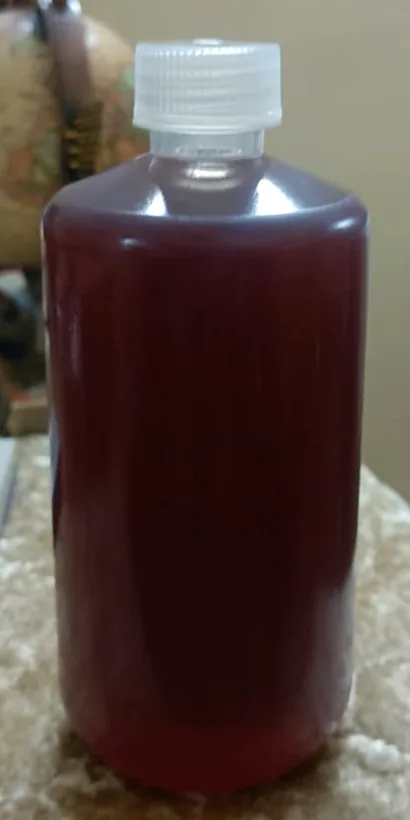
E904 food-grade shellac dissolved in food-grade ethanol, filtered and bottled, ready to load into your sprayer. Sample bottle shown; bulk supplied in sealed containers approved for flammable liquids.
The liquid saves you the mixing, filtering and solvent-handling step and arrives at a consistent strength. Because it is mostly ethanol, you pay freight on the solvent as well as the resin, and it must travel as flammable dangerous goods. The powder is the lower-cost choice for big volumes and distant destinations, keeps longer, and lets you adjust strength between apple varieties. The steps below are for buyers who choose powder.
| Grade | Dewaxed bleached shellac (wax-free bleached) · E904 / INS 904 |
| Wax | ≤ 0.2% |
| Rosin | Absent |
| Lead | ≤ 2 mg/kg · arsenic and mercury values on the batch COA |
| Form | Off-white to light-yellow powder (dissolves fastest) or granules |
| Packing | 25 kg double-lined bags or cartons |
Use only the dewaxed, bleached E904 grade for fruit. Orange, lemon or blonde flakes, seedlac and waxed grades are technical grades for wood and coatings, not food. Waxed shellac also leaves a hazy film.
Making the glaze from powder
- Use food-grade ethanol, 95% or stronger. Never use denatured or methylated spirit, which can contain methanol and other substances that must not go on food. Check that the ethanol is permitted for food use in your country.
- Use a clean, closed vessel of stainless steel, glass or food-grade HDPE. Avoid iron or mild steel, which can darken the solution.
- Add the powder slowly into the stirred ethanol, not the ethanol onto the powder, so it does not form lumps. Keep stirring until all of it is wetted.
- Let it dissolve fully. Powder dissolves in a few hours with occasional stirring; granules take longer. Keep the vessel closed so the ethanol does not evaporate.
- Filter through a fine mesh or food-grade cloth to remove any undissolved particles that could block spray nozzles.
- Label and date each batch and store it closed, in a cool place, away from flames. Make batches you will use within a few weeks.
How strong the solution should be depends on your apple variety, line speed and spray equipment, so settle it with your own trials. The table below only converts a target strength into a recipe. For reference, one published apple trial used a 20% shellac solution, applied as a thin film.
| Target strength (by weight) | Shellac powder per 1 kg ethanol |
| 5% | about 53 g |
| 10% | about 111 g |
| 15% | about 176 g |
| 20% | 250 g |
These figures are arithmetic for trial batches, not a recommended dose. A thinner solution gives a thinner film. Most faults on fruit come from too much coating, not too little.
Applying it on the apple line
- Wash the apples and remove dirt and residues.
- Dry the surface completely with air knives, sponge rollers or a dryer. Coating sprayed onto wet fruit streaks and turns cloudy.
- Spray a fine mist through nozzles over a bed of rotating brushes. The brushes turn the fruit and spread the coating into an even, thin film.
- Dry in a drying tunnel with moving warm air. An ethanol glaze dries fast; a heated tunnel helps on fast lines. In the published trial, coated apples were dried at 50 °C for 5 minutes.
- Grade, pack and label once the fruit is dry and no longer tacky.
Smaller packers can apply the glaze with a hand sprayer onto fruit turning on brushes, then air-dry it. The rule is the same: dry fruit in, thin coat, fully dry before packing.
Safety: ethanol vapour is flammable. Work in a well-ventilated area, keep flames, sparks and hot surfaces away from the spray zone and solvent store, and use equipment suitable for flammable solvents.
Ethanol glaze or water-based coating?
| Point | Ethanol solution · water-based (ammonia) shellac |
| Made from | E904 shellac + food-grade ethanol · E904 shellac dissolved in dilute ammonia, often blended with wax emulsions |
| Drying | Fast, even with little heat · slower; needs a heated drying tunnel |
| Handling | Flammable; needs ventilation and solvent-safe equipment · not flammable; ammonia odour |
| Who uses it | Packers mixing their own glaze, hand application, smaller lines · large commercial lines buying a finished coating |
The resin is the same in both cases. Our fruit coating guide covers the water-based route used by coating formulators.
Problems to watch
- Coating too heavy. A thick shellac film slows the exchange of gases through the skin. In a published trial on 'Delicious' apples, shellac-coated fruit reached about 10% CO₂ inside the fruit, against 3.5% for uncoated fruit, and built up more ethanol, which can mean off-flavour later. Keep the film thin and test each variety before full production.
- Whitening (blush). When cold fruit comes out of storage and condensation forms on it, a shellac film can turn white or cloudy. Let fruit warm up gradually, and coat only fruit with a dry surface.
- Sticky or tacky fruit. The coating has not dried. Lower the dose, improve air flow in the dryer, or slow the line.
- Streaks and dull patches. Wet fruit, blocked nozzles or uneven brushing.
- Powder will not dissolve fully. Usually old or heat-damaged resin. Store shellac below 25 °C, dry and sealed, and use first-in, first-out. See why shellac blocks in storage.
Rules by market
European Union: shellac (E904) is authorised quantum satis, for surface treatment only, on apples and pears as well as citrus, melons, peaches, pineapples, pomegranates, mangoes, avocados and papayas (Regulation (EC) No 1333/2008, Annex II, as amended by Regulation (EU) No 1147/2012). Since Regulation (EU) 2026/189, only wax-free bleached shellac meets the E904 specification. Shoppers must be told that the fruit is coated.
India: FSSAI permits beeswax (white and yellow), carnauba wax and shellac as coatings on fresh fruit. Packages of coated fruit must state "Coated with wax", followed by the name of the wax, for example "Coated with wax (shellac)". Non-food waxes are not allowed.
United States and other markets: shellac-based apple coatings are widely used under national food-additive rules, and many markets require coated produce to be declared to buyers. Confirm the current rule for each destination before shipping coated fruit.
Ordering E904 shellac for apple coating
Powder or granules: ₹1,700 – ₹2,100 per kg (about US$17.5–21.6), minimum order 25 kg. Samples of 100–500 g are available for your own trials; the courier charge is deducted from your first bulk invoice.
Ready-to-use liquid: price on request. It depends on the shellac strength, container size, quantity and destination, because the ethanol and dangerous-goods freight are part of the cost. Tell us the strength you want, or ask us to suggest one for your trial. Request a liquid quote →
Every lot comes with a batch COA from a NABL-accredited laboratory; liquid orders also come with an MSDS for the solution. Shipping is FOB Kolkata, CFR or CIF; Bangladesh by road via Petrapole–Benapole.
Tell us liquid or powder, your apple volume per season, your coating method and your destination when you request a quote.
Quick answers
Do you sell ready-made liquid shellac for apples? Yes. We supply E904 shellac dissolved in food-grade ethanol, ready to spray, at the strength you specify. Price on request. We also supply the powder if you prefer to mix it yourself.
Liquid or powder — which is cheaper? Per kg of shellac, powder is cheaper: the liquid is mostly ethanol and ships as flammable dangerous goods. Liquid saves your mixing time and gives a consistent strength.
Which ethanol should I use? Food-grade ethanol, 95% or stronger. Do not use denatured or methylated spirit, or any solvent that is not permitted for food.
Can I use orange or lemon shellac flakes on apples? No. Only dewaxed, bleached shellac meeting the E904 specification is a food grade. Orange, lemon and blonde flakes are technical grades for wood finishing.
How long does the ethanol solution keep? Shellac solutions change slowly once mixed. Use our liquid within the period on its batch label, and make your own batches in amounts you will use within a few weeks. Keep it closed, cool and dated. The dry resin keeps about 12 months in cool, dry storage.
Is shellac allowed on apples? Yes, in the EU (E904, surface treatment only) and in India (FSSAI permits shellac on fresh fruit, with "Coated with wax (shellac)" on the pack). Check the rules for each destination.
This guide summarises publicly available regulations, published research and industry practice as of October 2026. Run your own trials, and verify the current rules for your market and your own quality agreement before use. It is not legal or food-safety advice.
Coating Apples This Season?
Ready-to-use liquid or powder to mix yourself. Batch COA with every lot, quotes within 24 hours.